
Medicare levy
Medicare levy and surcharge explained
What the 2% Medicare levy is, when the Medicare levy surcharge applies, and how each shows up on your tax return versus your payslip.

Step 01
Medicare levy
The Medicare levy helps fund Australia’s public health system. For most people it is 2% of taxable income. Taxable income is what’s left after allowable deductions, so a $1,000 deduction lowers the levy as well as your tax. The ATO’s own example makes this concrete. Matthew earns $76,000 and has $1,000 of deductions. His taxable income is $75,000, so his levy is $75,000 × 0.02 = $1,500. He doesn’t calculate it himself; the ATO works it out when his return is processed. Some people pay less. Family-income reductions exist too. Full or half exemptions apply to specific cases: certain medical conditions, foreign residents, and people not entitled to Medicare benefits. The ATO says to check reduction and exemption eligibility separately.
| Situation | Taxable income | Result |
|---|---|---|
| No levy | At or under $28,011 | 0% |
| Reduced levy | Above $28,011 up to $35,013 | Phased reduction |
| Full levy | Above $35,013 | 2% of taxable income |
Higher thresholds apply if you get the seniors and pensioners tax offset. ATO example: Angie, single, taxable income $29,000, pays a reduced levy of $98.90.
The levy is based on taxable income, not what’s on your payslip. A low-income year can mean a reduced levy or none, even if you worked part of the year at a higher rate.
Step 02
Medicare levy surcharge (MLS)
The surcharge is a separate charge for people who earn above a threshold and don’t have an appropriate level of private patient hospital cover for themselves, their spouse and their dependent children. It is paid on top of the levy. Which rate applies depends on your income for MLS purposes: taxable income plus reportable fringe benefits, net investment losses and reportable super contributions. If you have a spouse, your combined income is used.
| Income for MLS purposes | 2025–26 single | 2025–26 family | 2026–27 single | 2026–27 family | Rate |
|---|---|---|---|---|---|
| Base tier | ≤ $101,000 | ≤ $202,000 | ≤ $105,000 | ≤ $210,000 | 0% |
| Tier 1 | $101,001–$118,000 | $202,001–$236,000 | $105,001–$123,000 | $210,001–$246,000 | 1% |
| Tier 2 | $118,001–$158,000 | $236,001–$316,000 | $123,001–$164,000 | $246,001–$328,000 | 1.25% |
| Tier 3 | $158,001+ | $316,001+ | $164,001+ | $328,001+ | 1.5% |
Family thresholds rise by $1,500 for each dependent child after the first.
The ATO’s example for 2026–27: Tom is single with taxable income of $90,000 and reportable fringe benefits of $27,000. His income for MLS purposes is $117,000, so he’s in Tier 1 at 1%. His surcharge is $117,000 × 1% = $1,170, calculated on his taxable income plus fringe benefits.
Hospital cover must be the right kind and cover the whole family for the whole year. Part-year cover means you may owe MLS for the days without it. Extras-only cover and travel insurance don’t count. Excess must be $750 or less for singles, $1,500 or less for couples and families.
Step 03
On your return
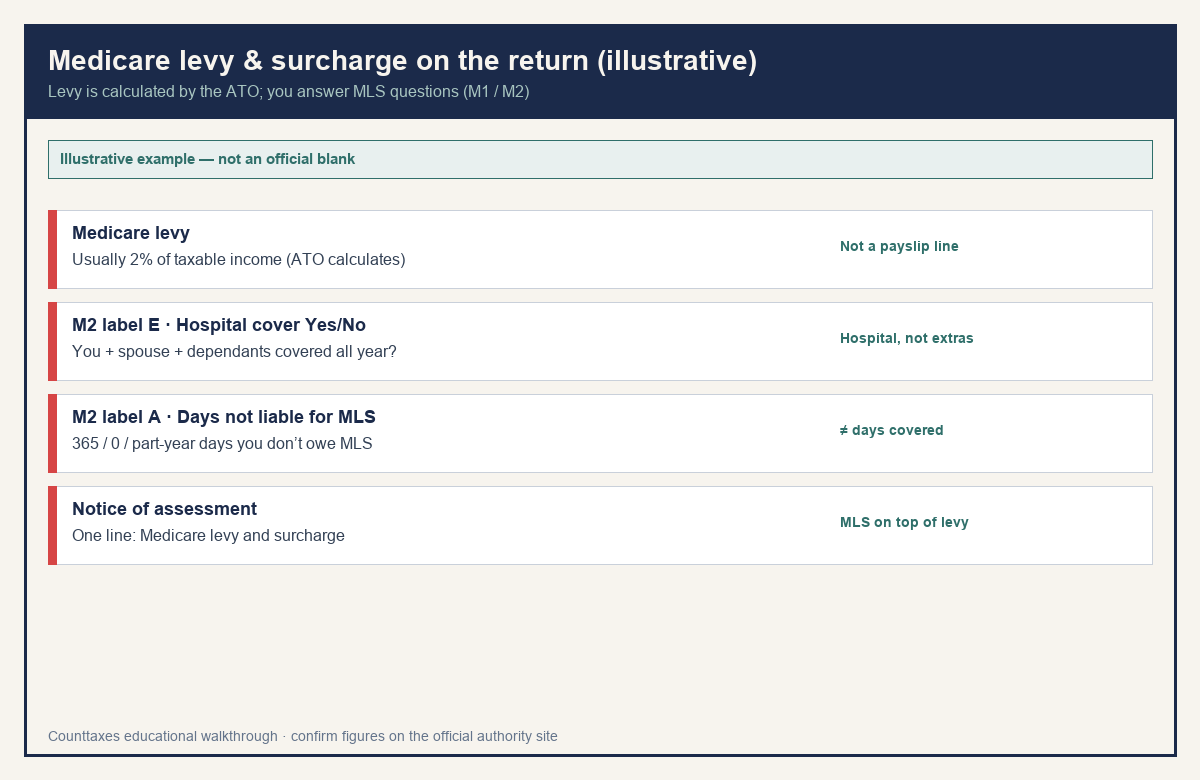
You don’t fill in a levy line. The ATO calculates the Medicare levy when it processes your return. What you do answer is the surcharge question. On the paper 2026 return it is M2; in myTax it’s the Medicare levy surcharge section. For M2, you answer whether you and all your dependants (including a spouse) had appropriate hospital cover for the whole of 2025–26 (label E, Yes/No). Then you write the number of days you did not have to pay MLS (label A). Write 365 if there’s no MLS for the year, or 0 if there’s MLS for the whole year. Questions M1 (reduction or exemption) and the income tests also feed the result. Your insurer’s private health insurance statement helps. It shows the number of days your policy provided appropriate cover. Use it to complete the MLS question. The result appears on your notice of assessment as one amount, Medicare levy and surcharge. If MLS applies, it’s added to your tax liability, which may mean a smaller refund or a tax bill.
The “days” figure on your insurer’s statement counts days of cover. The days at M2 label A are days you don’t owe MLS. They often match, but exemptions, a change of spouse, or family members without cover can make them differ.
Step 04
Vs payday withholding
Payday and the annual return answer different questions. Your employer withholds PAYG tax using ATO tax tables. The ATO says that amount generally includes an amount to cover the Medicare levy. The levy itself is only calculated when you lodge. MLS is different. The ATO says it isn’t covered in the tax withheld by your employer. If you owe it, it’s added at assessment, and that can reduce a refund or create a bill. If you expect to owe MLS, you can give your employer a Medicare levy variation declaration (NAT 0929) and ask them to withhold extra to cover it. The same form is used to claim a levy exemption or reduce the amount withheld for the levy. Give a new form when your circumstances change, such as a new payer, a new partner, or a change in cover. Remember the 2026–27 shift: the single MLS base threshold is now $105,000. Pay rises that cross it, or buying and dropping hospital cover, change what you’ll owe at tax time even if your payslip looks the same. Got a raise or changed jobs? Estimate your new take-home pay with the Counttaxes Australia calculator, then check whether you’re near an MLS threshold before tax time.
MLS isn’t covered by employer withholding by default. Optional extra withholding via NAT 0929 is separate — confirm current-year figures on the ATO form page before you rely on any printed thresholds.
Official source
Always prefer the current-year instructions over this outline.
Keep reading
Related Australia guides
 Individual tax return
How to lodge a tax return in Australia
Who needs to lodge, what to gather, and how myTax and your income statement fit together for the 2025–26 return. Not a filing service.
 Income statement
PAYG summary / income statement explained
Most PAYG payment summaries are now income statements in myGov. Where to find yours, what the figures mean, and why it differs from your payslip.
 PAYG withholding
 explained
How Australian PAYG withholding works for employees — TFN declaration, tax-free threshold, STP income statements, study loans, and when missing a TFN raises withholding.