
T2125
How to fill out a T2125
See who files CRA Form T2125, how income and expenses flow to your T1, and how self-employed pay differs from payday.

Step 01
Who uses T2125
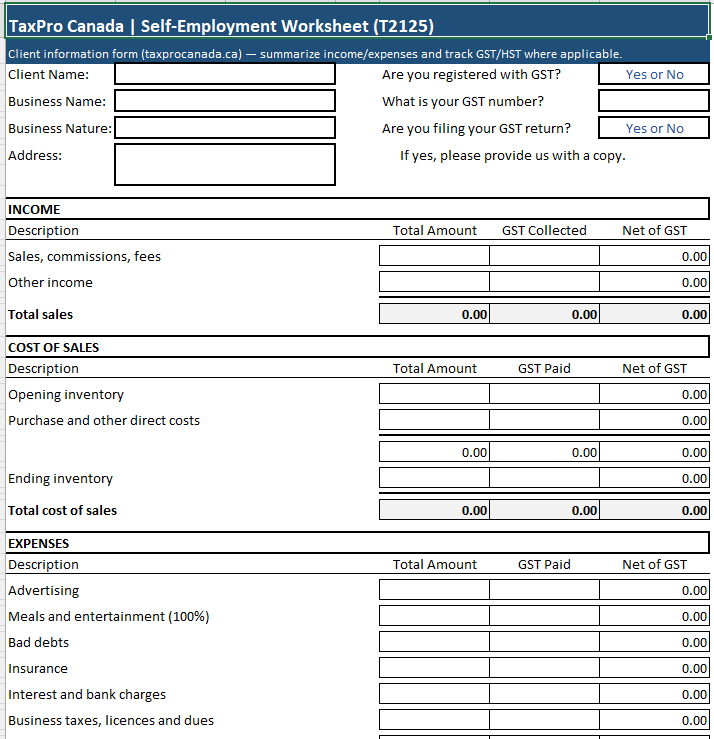
T2125 is the Canada Revenue Agency’s form for reporting income and expenses from working on your own account. If you’re a sole proprietor, or a partner in a partnership that runs a business or profession, this is the statement that turns your sales and costs into a net income figure for your tax return. CRA’s guide covers business people, professionals, self-employed commission salespeople, and people who run a daycare from home. Gig work, ridesharing, short-term accommodation sharing, online sales and social media income all count as business income. That includes tips, gifts and goods you receive in return for your work. You fill out one T2125 per business. If you have both business income and professional income, that’s two forms. Farmers use T2042 and fishers use T2121 instead. If your business is incorporated, T2125 isn’t your form at all. The form doesn’t replace your T1. You file it with your return.
Being paid by a company doesn’t automatically make you self-employed. CRA looks at the working relationship, including who decides where, when and how the work is done.
Step 02
Income and expenses
Start with the identification part: your fiscal period and a six-digit industry code. Most self-employed people use a December 31 year-end. Income starts at amount 3A (gross sales including GST/HST), then 3B subtracts GST/HST and returns. The adjusted figure (3G) goes to line 8000. Expenses live in Part 4. Only the business-use part counts. Most self-employed people must use the accrual method. Commission agents, farmers and fishers can choose cash.
| Callout | What it means | Common mistake |
|---|---|---|
| Industry code (Part 1) | Six-digit NAICS for your main activity | Picking a vague code with trailing zeros |
| Amounts 3A / 3B / 3G | Gross including GST/HST → adjusted gross sales | Entering net sales at 3A |
| Line 8299 | Gross business / professional income → T1 13499 / 13699 | Treating it as net income |
| Line 8523 | Meals and entertainment (generally 50%) | Entering the full amount |
| Line 9369 | Gross minus expenses, before adjustments | Calling it final net income |
| Line 9946 | Your net income → T1 13500 / 13700 / 13900 | Skipping Part 5 and copying 9369 |
Meals and entertainment are generally limited to 50%. Buying equipment isn’t a same-year expense — it usually goes through capital cost allowance. Download CRA’s current T2125 and Guide T4002 for the exact lines.
Step 03
Vs payday
A payslip and a T2125 sit on opposite sides of the tax year. On payday, an employer handles tax on your behalf. With T2125 you report the full year after the fact, and nobody withholds anything from client payments for you. Your net self-employment income goes on your T1. That return also carries CPP contributions on self-employment earnings. If you register for EI as a self-employed person, premiums are worked out on the return too. To avoid one large bill, CRA may ask you to pay instalments. For business, professional or commission income, those are due March 15, June 15, September 15 and December 15. If a date falls on a weekend or holiday, the next business day applies. If you’re comparing a salaried offer with contracting, run the payday side first. The Counttaxes Canada take-home calculator shows what a regular paycheque looks like after deductions. Then compare it with the net figure you expect on T2125, after tax, CPP and any instalments.
GST/HST is a separate obligation. CRA’s guide says registration is generally required once taxable revenues pass $30,000 in a single quarter or over four consecutive quarters.
Official source
Always prefer the current-year instructions over this outline.
Keep reading
Related Canada guides
 T1
How to fill out a T1
A plain-language overview of the T1 Income Tax and Benefit Return — slips, schedules, and when software vs paper applies. Not a filing service.
 TD1
How to fill out a TD1
What the CRA TD1 form does, how to claim the basic personal amount, federal vs provincial forms, and what to enter with two jobs.